


Welcome back to Ad Nauseam, where I once again dig through the glittery landfill of comic book advertisements like an archaeologist who majored in terrible decisions. If you’ve ever wondered what life was like before ad targeting —don’t worry, comic books already had you covered with full-page pitches for romance novels, forgotten sitcoms, and products that look like they were invented during a sugar crash.
Tonight we delve between the chaos of Sonic The Hedgehog #10 released February 1994.
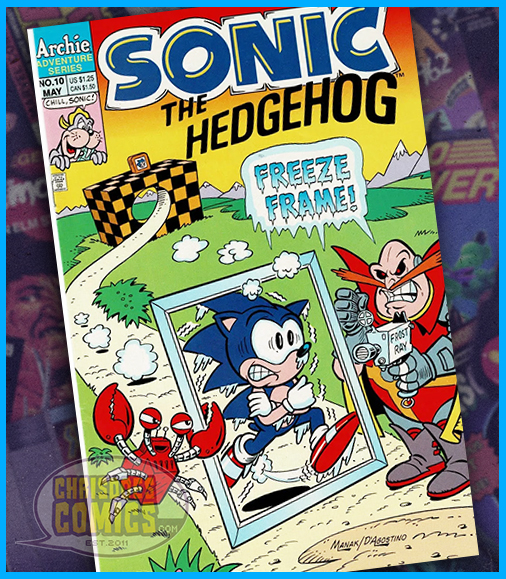
Personal trivia: This is the first comic book I ever owned.
The Archie Adventure series of Sonic the Hedgehog comics started in the early ’90s with someone at a board meeting saying, “What if we took a video game about running fast and made it thirty-page political drama with family trees, kingdoms, betrayals, and emotional trauma?” And everybody just nodded like that was the most normal thing in the world. It began as a bright, cartoony, Saturday-morning-style adventure where Sonic quipped, Robotnik schemed, and you could kind of pretend the laws of physics still mattered. But as time marched on, suddenly Sonic isn’t just a blue hedgehog—he’s a freedom fighter in a violent war-torn world with enough lore to make J.R.R Tolkien say, “Sonic, slow the f*ck down, boy.”
Over time the series became legendary for turning a franchise known for “gotta go fast” into “gotta read this 12-part crossover or you’ll be confused forever.” The comic kept evolving, adding new characters, alternate universes, romance subplots, dramatic betrayals, and the kind of continuity where one poorly timed retcon could collapse reality like a Jenga tower made of hedgehog angst. And somehow—somehow—it worked for years, building a fanbase that wasn’t just reading comics, but maintaining a long-term relationship with an ongoing continuity experiment.
So grab your slap bracelet, lower that Ace of Base song and your standards, and join me as we revisit an era when every purchase required a mail-in form, a check your parents didn’t approve, and the confidence of a kid who genuinely believed an Archie-themed water bottle would change their life.
———————————————————————————————————
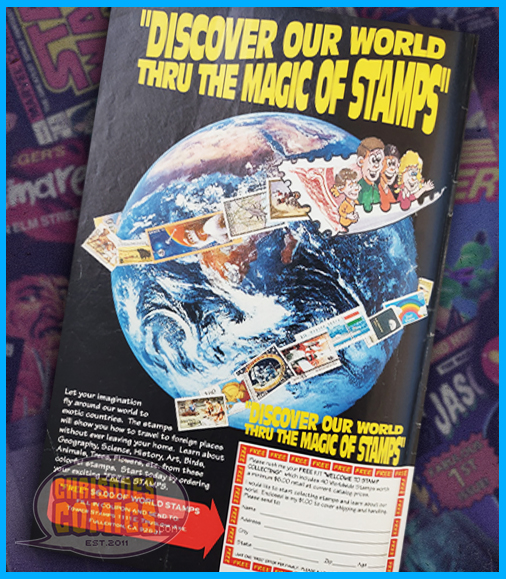
The Magic of Stamps
Did you ever personally know anyone who collected stamps? “Stamp collecting” has to be one of the most often referenced hobbies growing up, yet I never knew anyone who took part in it. Recently I found out a friend of mine was, indeed, a stamp collector. It was “uncovered” almost as if it was a dark secret. She mentioned it casually with almost an immediate shock of regret once the information was out there. My immediate response wasn’t mockery or laughter…it was intrigue.
This is an age old “hobby” or so we’ve been told. And I wanted to know what makes a person want to passionately collect stamps. I got nowhere with her, only that she had a fascination with the United States Postal Service since she was a child. And her stamp collecting “hobby” was not to be delved into any further. As if it was akin to a traumatic childhood experience.
Okay…so now I’ll mock: Stamp collecting is the ultimate thrill ride for people who look at tiny rectangles of paper and think, “This is the adrenaline I’ve been missing.” Nothing says “living on the edge” like spending your weekend organizing postage from 1973 and whispering “mint condition” like you’re handling ancient treasure instead of a miniature sticker your grandma licks. It’s basically Pokémon, but with dead eyed historical figures and tweezers—with the biggest plot twist realizing you’ve become the kind of person who owns a magnifying glass on purpose.
My favorite thing about this advertisement is how it states this is all “free” including the little order form literally surrounded by the word “free”. Yet also instructs to include $6 to begin your “free” journey to stamp collecting. It puts “free” in quotes because it knows what it’s doing. But how bold is that? To state something being ”free” yet you have to pay to start. I almost admire the tenacity of this ad. It’s all free…for a price! You little, asshole, you.
Cap’n Crunch
Cap’n Crunch was born in the golden age of “let’s see what happens if we put sugar on everything,” back when breakfast was less about nutrition and more about giving children the kind of energy reserved for small fireworks. Quaker Oats rolled him out in the early 1960s like, “Ladies and gentlemen, we proudly present: a cartoon sea captain who definitely smells like pure corn syrup and confidence.” His full name? Horatio Magellan Crunch. That’s not a cereal mascot—that’s a man who should be commanding a ship, pile driving new continents, and coming on to beautiful native women (in hopes of pile driving them as well) . And somehow, America looked at this naval officer and said, “Yes. I trust this man to feed my kids.”
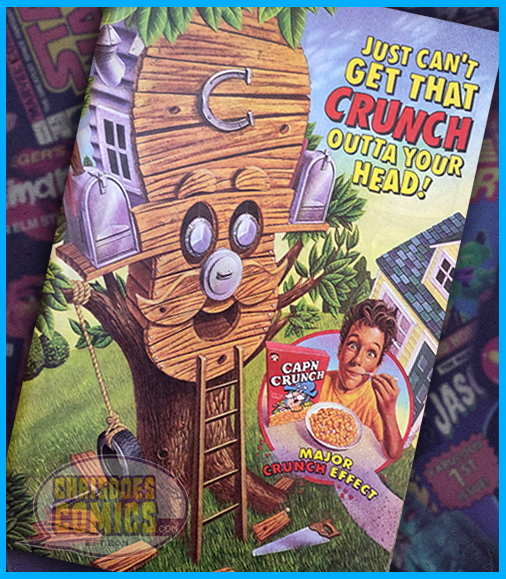
This ad is saying: “Cap’n Crunch is so crunchy, it will move into your brain and start paying rent.” Up top it screams “JUST CAN’T GET THAT CRUNCH OUTTA YOUR HEAD!” not like its a cereal, but a medical condition your doctor can only treat by prescribing “less breakfast violence.”
Just look at this haunted masterpiece: a giant wooden treehouse shaped like the Cap’n himself that says, “Help I can’t control my consumerism.” It’s half clubhouse, half sentient birdhouse, and 100% the kind of thing you build when you’ve eaten three bowls and your mouth is sandpaper. Meanwhile the kid is staring into the middle distance, spoon in hand, like he just experienced “Major Crunch Effect”—which sounds less like a slogan and more like the side effect section of a prescription commercial: “May cause intense jaw workouts, roof-of-mouth damage, and an unstoppable urge to say ‘CRUNCH’ like a pirate without dental insurance.”
After reviewing this ad, I really think Cap’n Crunch would’ve made a great prowrestler.
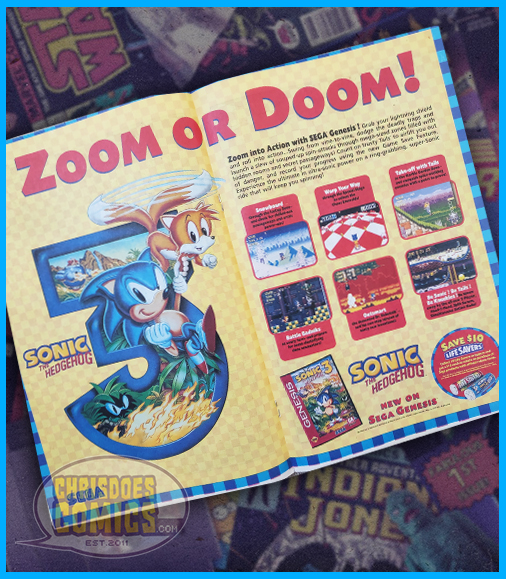
Sonic The Hedgehog 3
I can’t blame the ‘ol blue hedgehog to stick a bit of self promotion into his own comic book. Afterall, you must be reading this comic if you’re a Sonic fan to begin with. And in 1994, Sonic was fresh icon-status.
This ad comes in at full volume with “ZOOM OR DOOM!” like Sonic 3 isn’t a video game, but a legally binding contract where SEGA gets to repossess your thumbs if you even think about slowing down. Sonic and Tails are smiling like they’re not seconds away from launching you into a bottomless pit because you dared to enjoy the game’s scenery for half a second. But it’s not like you can master technique in those classic Sonic games, as you’d immediately be ricocheting off three springs, a robot, and an inexplicable stone circle at the speed of regret. Do you miss Mario yet?
The right side of the ad is pure 90s marketing poetry: tiny screenshots and a paragraph that’s basically, “Swing, dodge, launch, warp, outsmart, battle, take off—DO EVERYTHING ALWAYS.” It’s like they’re trying to sell you an action movie, a theme park ride, and an energy drink all at once. My favorite is the “save feature” being pitched like revolutionary technology—because back then, not having to restart your entire life after one mistake was considered a premium luxury experience. Meanwhile, the final punchline is the coupon screaming “SAVE $10 LIFESAVERS,” as if the true emergency here isn’t Dr. Robotnik… it’s your parents seeing the price tag of Sonic the Hedgehog 3.
Trivia: Sonic the Hedgehog 3 was $69.99 in 1994. Adjusted for inflation, that comes out to $154.60.
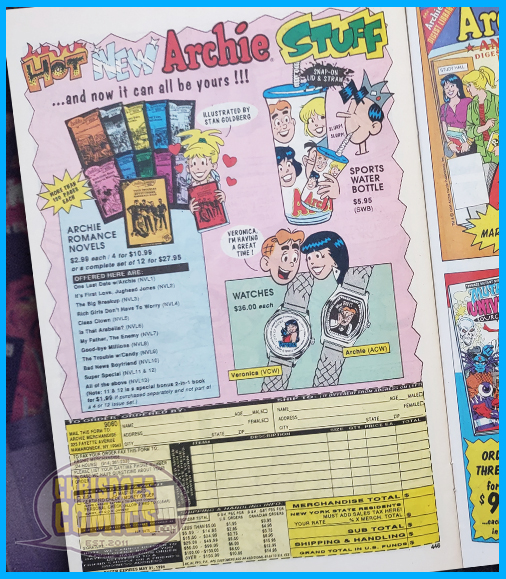
Hot New Archie Stuff
FINALLY. NEW ARCHIE STUFF. You know…Archie…the teen drama/comedy comic…from the 1940s. Well, he’s got new stuff.
Okay, I’m being a bit of a Reggie (Archie insider joke!) but here’s a little ChrisDoesComics insight: Besides Daredevil, Archie is the only comic I ever subscribed to. I needed Archie…consistently. Straight to my mailbox. The wholesome humor…the timelessness (or lack thereof)…and colorful classic artwork was a personal palette cleanser. It was pure simple escapism.
This ad is parading “HOT NEW Archie STUFF” has that chaotic catalog energy where everything is bright, loud, and aggressively wholesome—because nothing says “cool” like ordering romance novels through the mail while sitting next to the family landline, praying nobody picks up and destroys your entire future.
And look at these Archie Romance Novels… because obviously what the world needed was Archie but longer and more sincere. Nothing gets your heart racing like reading 120+ pages of Betty and Veronica stress-testing Archie’s ability to make the exact wrong choice in every situation.
But that sweet merch. Peak confidence: a “Sports Water Bottle” that’s basically a plastic cylinder of hope with a snap-on lid and straw so you can SLURP! SLURP! your way through heartbreak. And don’t sleep on the watches—$36 each so you can tell time while also telling everyone, “Yes, my wrist is in a committed relationship with Archie Andrews.” Imagine checking the time and seeing Archie’s face staring back like, “It’s 3:15… and I still haven’t learned a single lesson.” Timeless. Literally.
Honestly, the person that would want the Archie merch from this ad for the same reason people buy lava lamps and neon windbreakers: it’s pure, uncut nostalgia with zero practical purpose and that’s the charm. You’re not buying a “sports water bottle,” you’re buying the fantasy of being the kind of person who hydrates while emotionally invested in a love triangle. Those watches? That’s not about telling time—it’s about making a bold statement like, “Yes, my wrist runs on Riverdale Standard Time, where it’s always lunch period and someone is always flirting irresponsibly.” Owning this stuff is basically collecting tiny, wearable proof that you support a world where problems are solved with milkshakes, dramatic sighs, and Jughead eating something the size of a small sofa.
In other words, I’m headed to eBay to see if I can buy some of this crap.
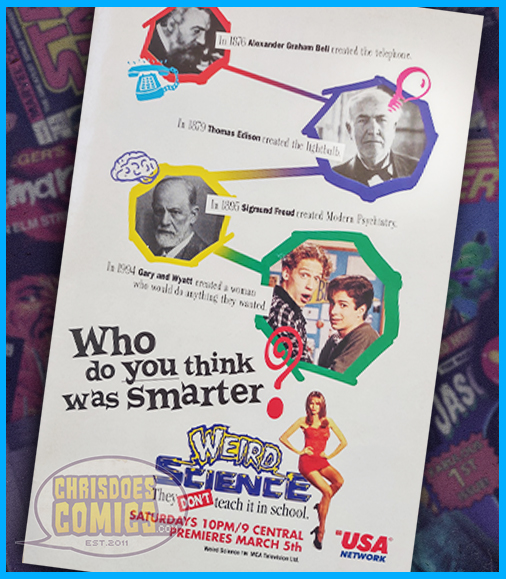
Weird Science 1994
Believe it or not, this was the third TV show based off a John Hughes movie. And it’s the only one that isn’t an utter failure.
Weird Science as a TV series seems like the entertainment version of a confused shrug: “Okay… so it’s that movie… but stretched into a weekly situation where science is a hot magic super model.” It existed in that 90s era where the plot is 10% story and 90% “what chaotic thing can happen before the commercial break?” A weekly reminder that two teenage boys should never be left alone with technology, because within five minutes they’ll summon a life lesson with cleavage and goofy special effects.
The show (like the film) treats science like it’s a vending machine: put in some hormones, push a button, and out comes chaos with a moral at the end. One episode you’re getting bullied, the next you’re dealing with a mutant monster, a military operation, or your own ego becoming a literal problem—you know, normal high school stuff. And Lisa, the iconic sex appealing creation, is essentially an overpowered genie-babysitter trapped in teen-boy logic. It’s wholesome, ridiculous, and exactly the kind of show that made you believe computers were lawless and haunted.
Yet it ran for 5 seasons. So there was an audience. Probably because Weird Science didn’t pretend to be anything else. It was the kind of show you watched while half-paying attention, yet somehow look up and go, “Why is there a mutant biker gang in their living room?” It didn’t need critical praise because it had something even more powerful: syndication energy. Not a “TV Hall of Fame” show… more like a “this is on and I’m not changing it” show—and honestly, that’s a beautiful kind of success. Scientific one might say.
And with that, thanks for joining me on this “educational” journey through 31-year-old comic book advertisements—because nothing says “productive use of time” like analyzing those mail-order dreams from 1994. I hope you walked away with something valuable, like a deeper appreciation for how aggressively companies once begged kids to send cash in an envelope, or the sobering realization that we were all one coupon away from owning an Archie watch and making it our entire personality. Until next time, stay nostalgic, and remember: history isn’t just dates and wars—it’s also neon graphics, tooth-rotting-cereal, and a generation of children absolutely convinced that a stamp collection would change their little lives.
Comfy comic culture–yadda yadda, all that good stuff…here on ChrisDoesComics.


