Welcome back to another dated and musty edition of Ad Nauseam! The only series of articles on the internet dedicated to digging through comic book advertisements for the sole purpose of directionless rambling disguised as “informative” nostalgia. It’s less an informative article and more of something you’d find in a digital clearance bin next to a scratched Madden 2003 disc. Excelsior.
Tonight, we’re doing things a little differently. We’re heading to Hell’s Kitchen.
Specifically, early 2000s Hell’s Kitchen—when Daredevil was finally getting his big break: A major motion picture. A marketing push. A moment where Marvel decided, “Hey, this guy might be worth something.”
So naturally, they tried to sell him in every possible way.
Before we get into that, though—it’s worth remembering why Daredevil even mattered in the first place…
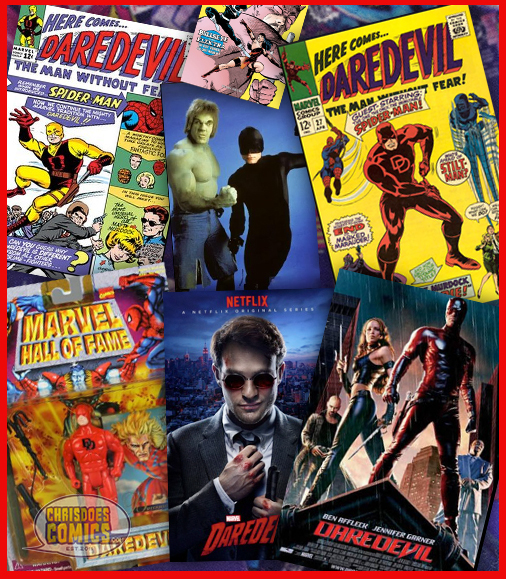
He’s always been a strange kind of superhero. Not because he’s blind—that’s the hook—but because everything around him feels grounded in a way most superheroes don’t. No alien invasions. No cosmic stakes. Just rooftops, alleyways, and a lawyer trying to hold things together through sound, instinct, and an irresponsible tolerance for pain.
He debuted in 1964, courtesy of Stan Lee and Bill Everett, originally leaning a little more swashbuckler than street vigilante. Bright colors. Big personality. It wasn’t until Frank Miller got involved that things shifted—hard. The tone got darker. The stories got heavier. Hello Catholic guilt!
That’s the Daredevil most people recall. Which makes what happened next interesting.
The 2003 Daredevil movie tried to bring all of that to the screen—and kind of landed somewhere in between everything. It wanted to be serious. It wanted to be edgy. It also wanted to slow-motion a playground fight while Evanescence played in the background.
Some people, like me, were just happy he showed up at all. At the time, you weren’t picky. If your favorite character got a movie, you took it. No questions asked.
But looking back…it didn’t quite land. Because while the movie was figuring itself out, Marvel was already busy trying to turn Daredevil into a product. Let’s take a look at what that actually meant.
So put down your IPod and turn off those silly VMAs as we flashback to 2003 to delve into the capitalist carnage featuring a superhero most people didn’t know existed nearly 40 years prior. Back to a time when you brought up Daredevil, most people thought you were talking about a guy in white jumping buses with a motorcycle.
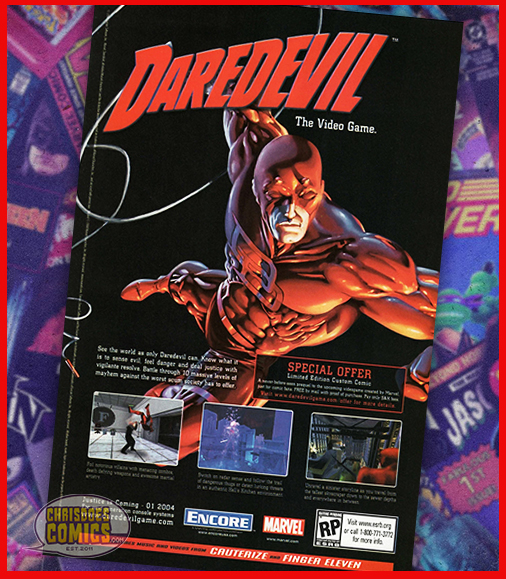
Daredevil: The Video Game (The One That Didn’t Exist)
There was supposed to be a Daredevil video game.
A real one. Not a mobile app. Not a throwaway tie-in. A full comic inspired console game where you’d actually be Daredevil—using radar sense, navigating rooftops, cracking skulls in Hell’s Kitchen like a morally conflicted ninja lawyer.
This was a big deal. Especially if you were 15 and desperately waiting for your favorite character to finally matter. And for a minute, it looked like it might actually happen.
The game was announced. Previewed. Marketed. Positioned as part of the bigger Daredevil push coming off the 2003 film.
And then…Nothing.
Canceled. Quietly. No dramatic ending. No redemption arc. Just gone.
Turns out making a compelling game around a blind superhero is harder than it sounds. Add in development issues and shifting expectations, and the whole thing collapsed before it ever hit shelves.
So what you’re left with is this ad. Not for a game you played—but for a game that almost existed. Which somehow feels very on-brand. Because being a Daredevil fan in the early 2000s meant getting this close to something cool…only for it to disappear.
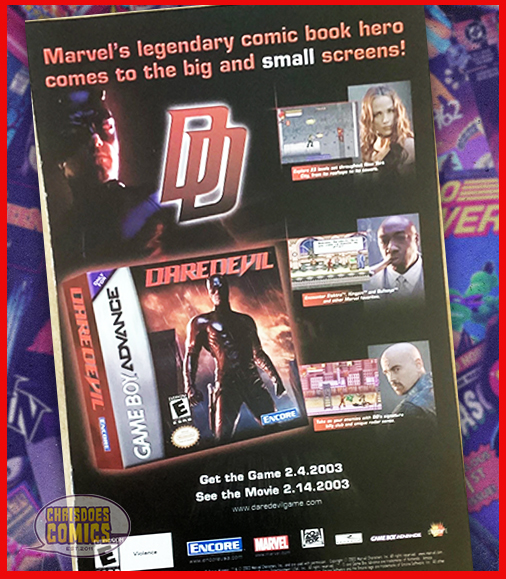
Daredevil: The Video Game (The One You Actually Got)
This one exists. Let’s start there.
Because if you were a Daredevil fan, your expectations had already been adjusted accordingly. What you got was Daredevil —a Game Boy Advance side-scrolling beat ‘em up that did exactly what it needed to do…no more, no less.
You moved left. You punched things. You occasionally remembered you were Daredevil. And honestly? It wasn’t bad. It just wasn’t the Daredevil game.
There were hints of something more interesting—radar sense mechanics, character-specific ideas—but everything was scaled down to fit the hardware. Which makes sense. It’s a Game Boy, not a miracle machine. Still, when you’re being told you can “see the world as Daredevil”…and what you’re actually doing is pressing A repeatedly to shin kick a generic thug for the 16th time, you start to notice the gap.
That said—I got this for my birthday. It was a big deal for me because it meant Daredevil existed outside of comics. You didn’t have to dig through clearance bins or explain your interests to confused store clerks. He was just…there.
Which, at the time, was enough. Also worth noting:
This is still the only Daredevil game we’ve ever really gotten.
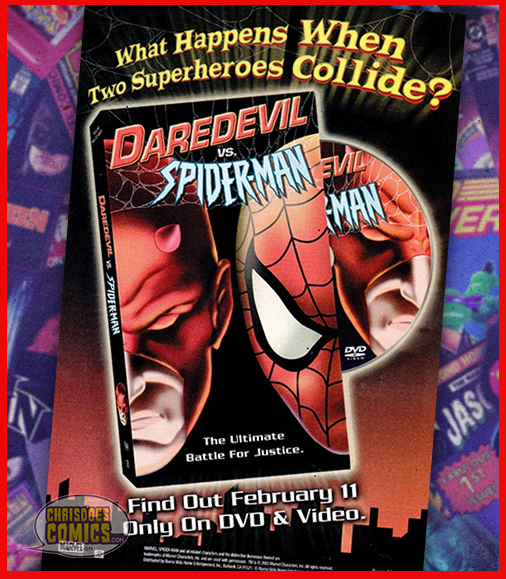
Daredevil vs. Spider-Man (Not Actually a Movie)
This is not a movie. It looks like one. It’s packaged like one. It’s sold like one.
It is not one.
What you’re actually getting here is a collection of episodes from Spider-Man: The Animated Series—specifically the arc where Spider-Man teams up with Daredevil to fight the Kingpin.
That’s it.
No new animation. No original story. Just previously aired content repackaged as an “event.” Which, to be fair, worked. Because in a pre-streaming world, this was a solid deal. You got a chunk of a show you liked, maybe a few bonus features, and if you were lucky, Stan Lee explaining something in a way that made you feel smarter than you actually were.
But the way it’s sold? That’s the fun part: “Two superheroes collide.”
No they don’t. They cooperate. Calmly. Over several episodes that already existed.
Collision? Nah, it’s a rerun with better marketing.
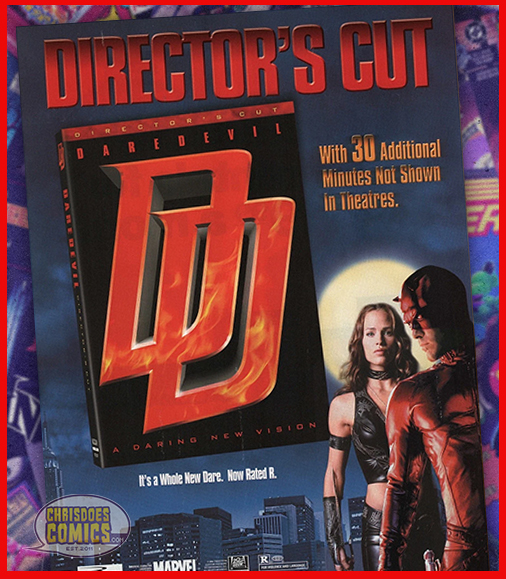
Daredevil: Director’s Cut (Same Movie, Now With Regret)
This is the same movie. Let’s just clear that up.
The Daredevil Director’s Cut is not a sequel. Not a reboot. Not a reimagining. This one feels like a course correction.
Big, bold—DIRECTOR’S CUT—right at the top. No ambiguity. No buildup. It’s not trying to sell you on Daredevil anymore—it’s trying to resell you on the same movie—but now it’s allowed to be better. Thirty extra minutes. A darker tone. A subplot that actually gives Matt Murdock something to do as a lawyer. It adds structure. It adds weight. It adds the feeling that someone, somewhere, realized what the movie should’ve been the first time.
And to its credit—it does improve things. Not dramatically. Not enough to completely rewrite history. But enough that you can see the version of Daredevil that almost worked.
Which is exactly what this ad is selling. Not something new. Just…what you were hoping for the first time. A more complete version. A version that aligns a little closer to what Daredevil actually is, instead of what early 2000s superhero movies thought he should be.
Whether it fully gets there is up for debate.
But compared to the theatrical cut, it’s at least pointed in the right direction. And Coolio has a prominent role. Bet you didn’t have that on your bingo card, bucko.
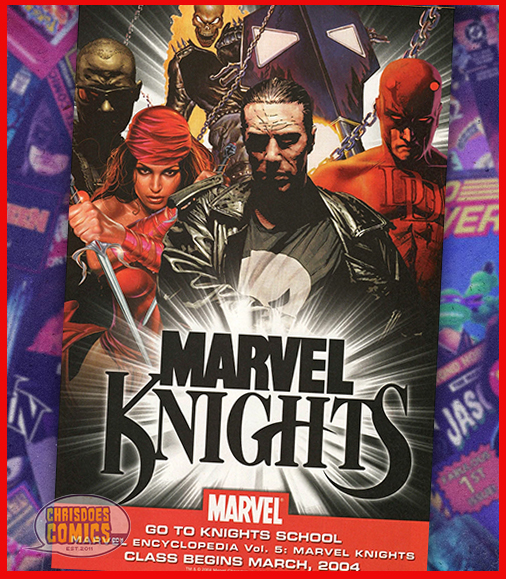
Marvel Knights (Comics You Could Defend in Public)
This isn’t really a product. It’s a reputation.
Marvel Knights was Marvel’s late ‘90s attempt to say, “Hey—these comics aren’t just for kids anymore.” Darker tone. Stronger writing. Street-level characters dealing with things that didn’t involve saving the universe every other Tuesday.
This is where Daredevil really came into his own. And what’s being sold here isn’t a story—it’s validation. A book that lets you point and say, “See? This is serious.”
Because Marvel Knights was never really about a single story—it was about a shift in how these characters were presented. And this ad captures that pretty well. It’s less “buy this” and more “this is what Marvel looks like now.”
Personally speaking, Marvel Knights were comics you had on hand in an environment that deemed comics “nerdy”. Launched in 1998 as a way for Marvel to rebuild some of its struggling characters by handing them over to creators with a bit more freedom and a clearer vision. Led by Joe Quesada and Jimmy Palmiotti, the line focused on street-level heroes like Daredevil and Punisher, giving them darker, more grounded stories. It ended up playing a big role in Marvel’s late ‘90s comeback—proving that stronger creative direction and tone could matter just as much as the characters themselves.
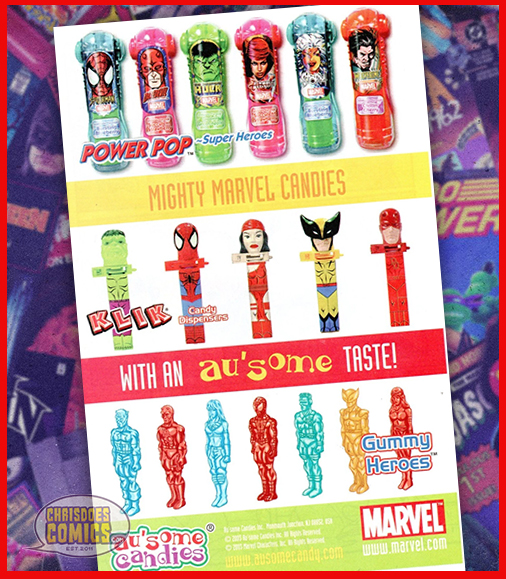
Marvel Candy (HULK SMASH TOOTH ENAMEL!)
This one feels like Marvel just decided, collectively, “Yeah…we can make our superheroes anything.”
And not in a subtle way. Not in a curated, brand-conscious way. Just—full commitment. You’ve got Spider-Man, Daredevil, Hulk, Elektra, Storm, Wolverine—all lined up like they just got drafted into the candy aisle against their will. No story. No context. Just vibes. And sugar.
And the best part is—this ad doesn’t even pretend to focus. It’s like three different marketing pitches collided mid-air and no one bothered to clean it up. Lollipops at the top. Candy dispensers in the middle. Gummy body horror at the bottom. Pick your cavity.
You want Daredevil—the morally conflicted, Catholic guilt-ridden vigilante of Hell’s Kitchen? Great. He’s now a bright red plastic tube filled with something that probably tastes like “vaguely cherry.” That internal struggle? Gone. Replaced with a plastic throat slit that pops out sugar discs.
Wolverine looks like he’s about to dispense candy with the same intensity he usually reserves for violence. Hulk is…green flavored. Storm is apparently blueberry now. These characters have been distilled down to two things: color and sugar profile. Which, to be fair, is kind of impressive.
What you’re actually looking at are licensed products from Au’some Candies—the “Power Pop” line (basically oversized novelty lollipops), “Klik” dispensers (knock off pez dispensers), and “Gummy Heroes” (which feel less like snacks and more like something you’d find at the checkout counter of a sex shop).
This isn’t about storytelling. It’s not even really about candy. It’s about brand recognition doing all the work.
Because even when these characters are reduced to brightly colored sugar shapes and plastic tubes, you still know exactly who they are. And that’s the whole strategy. No explanation needed. Just slap a logo on it, give Hulk a flavor (Gamma Green Apple, Baby) , and call it a day.
Somewhere out there, Daredevil is brooding on a rooftop.
And somewhere else…he’s a strawberry candy dispenser sitting next to the register for $3.99.
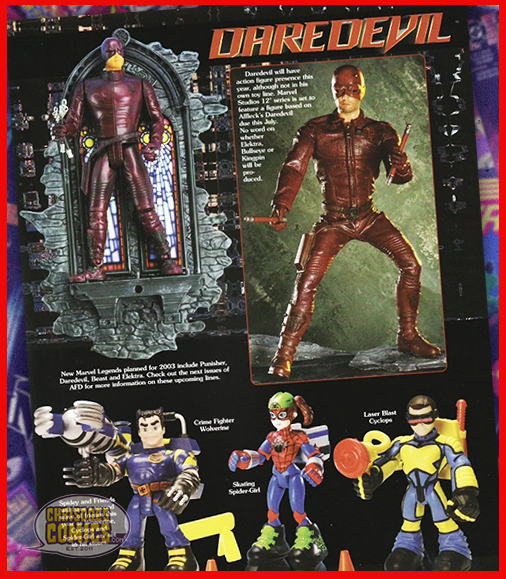
Daredevil Movie Action Figures (Braille NOT Included)
Daredevil didn’t get a full toy line. Let’s start there.
Other movies did. Spider-Man, X-Men, Hulk—they got everything. Figures, vehicles, roleplay gear, probably breakfast cereal.
Daredevil got…one. A single figure tucked into the Marvel Legends line. And you took it. Because that’s what being a Daredevil fan was. You didn’t collect. You accepted what was available. And, like me, if you were in high school? You hid it. Because the real challenge wasn’t finding the figure. It was not getting caught looking for it.
Because flipping through a page like this, staring at Daredevil posed like he just stepped out of a rain-soaked alley, you felt like you were looking at something you weren’t supposed to be this interested in anymore. This wasn’t “yeah I saw that movie.” This was studying the articulation. This was planning shelf space. This was knowing, deep down, that if anyone walked up behind you at that exact moment, you’d have to immediately pretend you were just looking at it to, um, make fun of it?
Spider-Man? Safe. Relatable. Mainstream. Socially acceptable.
A doll of Ben Affleck in tight leather? You had to explain that one. Which made it worse.
Now you’re not just “the kid looking at toys”—you’re the kid explaining why a blind lawyer vigilante in a leather suit is actually really cool, while holding what is, objectively, a small plastic man. It’s a tough sell in between getting your head dunked in a toilet.
And yet—I still wanted that damn Daredevil figure. Badly.
Because it felt like something under the radar. Not the obvious choice. Not the one everyone else had. If you managed to track one down, it felt justified. Like you pulled it off without anyone noticing. Which, looking back, might’ve been the real game all along.
Not collecting. Just not getting caught collecting.
I’m writing this because I decided to revisit 2003’s Daredevil film and, while I was on that nostalgic kick, decided to watch the Director’s Cut as well. I haven’t seen these in over 20 years, and it was surprising how much I remembered. So many little ticks, nods, and details. It reminded me how obsessed these comic book characters and their portrayals were in my little lonely teenage world.
The whole experience was pretty silly overall, yet, endearing. It brought me back to a very specific time and place in my life. It also made me realize how these old “critical failures” aren’t much different than the “successful” Marvel/superhero movies of the past 5 years or so. But, more importantly, it sparked that love for Daredevil once more. At a time where it almost felt forbidden: you’re too old for these characters, for these toys, for these comics.
Bullshit.
At the end of all this, somewhere between the canceled games, the repackaged DVDs, and the candy that probably expired in 2004…I start to realize it wasn’t really about any of it.
Not the ads. Not the products. Not even whether any of it was actually good.
It was about catching glimpses of Daredevil out in the wild.
Because being a Daredevil fan back then meant living off those moments. He wasn’t everywhere. He wasn’t the face of anything. He wasn’t on every backpack, lunchbox, or cereal aisle endcap. You had to find him. And when you did—whether it was buried in a video game ad, squeezed onto a DVD cover, or inexplicably molded into a gummy—you felt like you discovered something you weren’t entirely sure you were supposed to have.
Like you were in on something. And yeah…a lot of this stuff was ridiculous.
A blind, morally conflicted vigilante reduced to a cherry-flavored novelty tube. A collection of 10 year old cartoons reassembled as “new”. A video game that vanished before it even had the chance to disappoint you properly. It’s all kind of absurd when you line it up like this.
But at the time? It mattered.
Because every one of these ads meant the same thing: he was still around. Still fighting for shelf space. Still trying to break through. Still hanging on in a world that didn’t quite know what to do with him.
Which, honestly, feels very Daredevil.
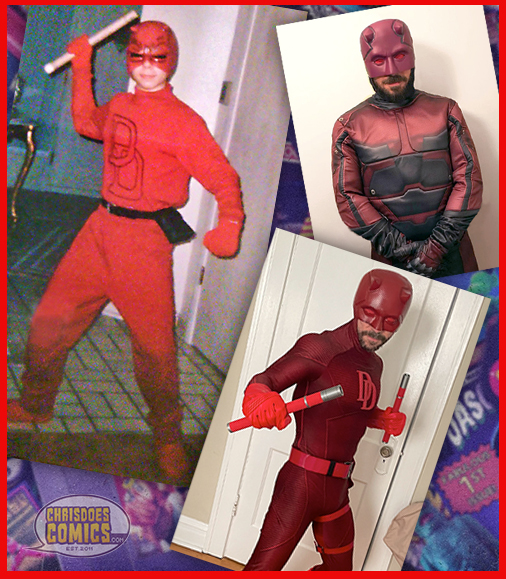
He’s never been the easiest character to sell. He doesn’t fit neatly into the big, loud, spectacle-driven version of superheroes. He’s smaller. Messier. Built on contradictions and bad decisions and getting back up when he probably shouldn’t.
And maybe that’s why this stuff sticks.Not because it was perfect—but because it wasn’t.
Because being a fan of Daredevil was never about having the biggest, best version of anything. It was about taking what you got, holding onto it, and finding something meaningful in it anyway.
Even if that something came in the form of a bootleg Pez dispenser or impractical keychain.
So yeah—these ads are weird. A little clumsy. Occasionally unintentionally hilarious.
But they also feel like time capsules.
Of a character trying to break through.
Of a fanbase quietly rooting for him.
And of a time when just seeing Daredevil outside the pages of a comic book felt like a small win.
And, Disney be damned, it still does.
Anyway—thanks for digging through 20+ year old ads exclusively involving a blind lawyer that fights ninjas in a red onesie. It wasn’t that pointless was it? Just a little. Like Daredevil’s horns.
You’ll always find articles exploring comfy comic culture here on ChrisDoesComics.
Live without fear, true believers.


